
Hill House

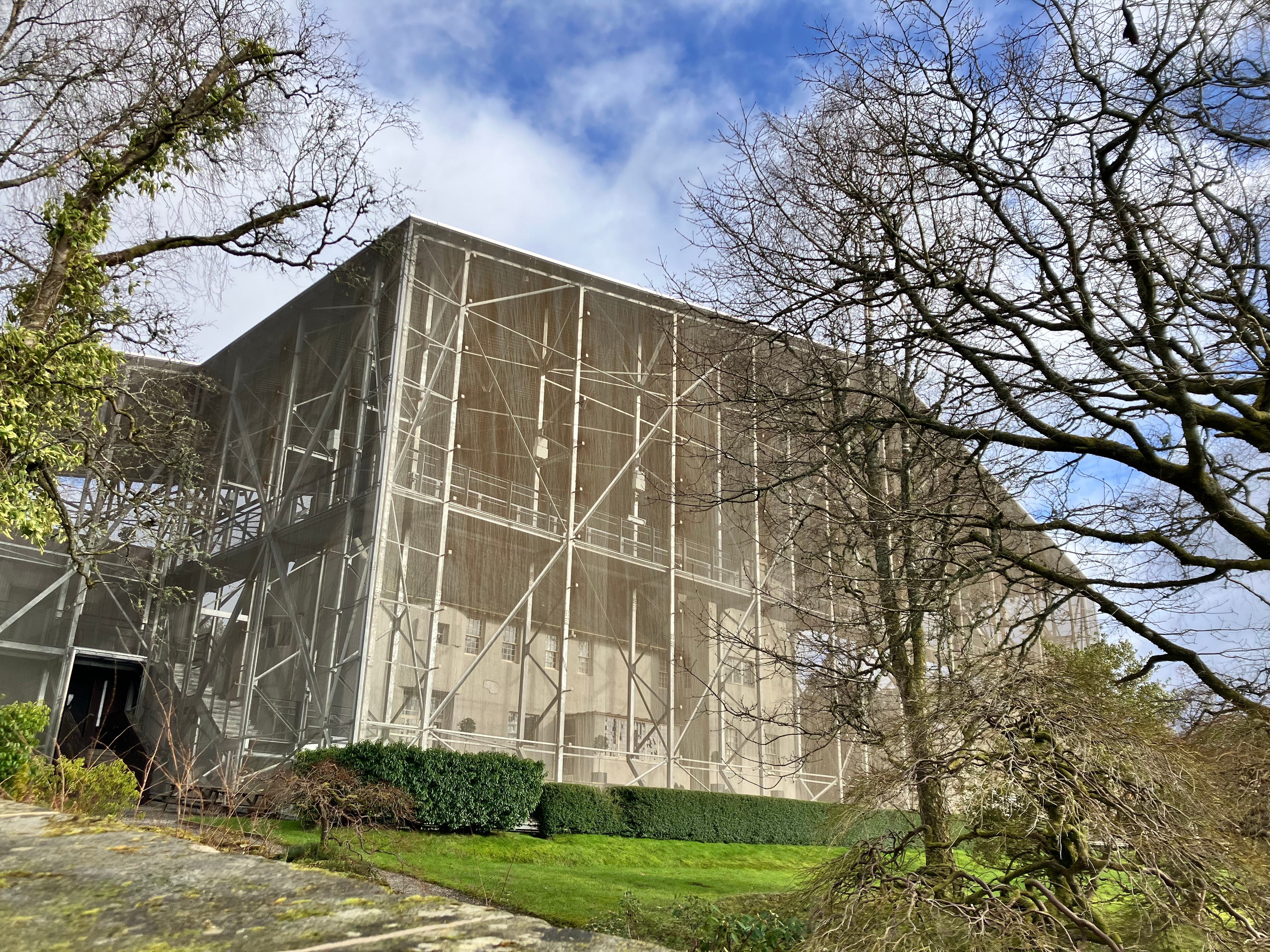
When I hear “chain mail,” I think of knights and armor, not houses. That is, until I learned about Hill House, a building enveloped by chain mail made of 32.4 million rings of stainless steel.
Let me back up a bit. We’ve finally left the bucolic village of Tayvallich for the big city of Glasgow. The view that we can afford in a tiny rural village during the tourist off-season is a bit better than the view we can afford in Glasgow, but we no longer have to drive 25 minutes to get to the nearest grocery store and are now around the corner from a great vegan restaurant, so it’s all about the tradeoffs…


We’re also a short walk from the River Clyde, which has always struck me as a funny name for a river. It’s like calling a river Margaret — great human name but would be a strange name for a body of water. There’s some dispute about this, but it’s thought that the River Clyde was named after an ancient Celtic goddess.
There are some unimpressive parts of the Clyde (though I did grow up a few blocks from a beautiful part of the Mississippi River so I’m admittedly a River Snob), including a stretch that’s a worrying shade of brown foam. The wildlife doesn’t seem to mind; we saw four alarmingly large swans floating near the rowing club the other day (if I was a rower, I’d go ahead and skip practice).
We saw more of the Clyde during our train ride to Helensburgh, the home of Hill House. There were rocky beaches and sandy beaches, and the river starts to become enormous, at some point turning into the Firth of Clyde. I’ve learned all sorts of new water terminology here on the west coast of Scotland, where the sea and land and lakes and rivers all seem to meld and bend into each other in surprising and blurry ways. A firth is basically an estuary, although the Firth of Clyde is enormous, something like 1,500 square miles. The boundary between the River Clyde and the Firth of Clyde is nebulous; all I know is that when we walked by the Clyde in Helensburgh, it smelled like the sea.
Helensburgh is a pleasant town full of beautiful old houses that I think could be classified as manors. Lots of turrets and grand driveways. After fortifying ourselves with coffee and treats, we began a 20 minute walk up a hill. Because of course something called Hill House can never be at the bottom of the hill - it’s always at the top!
Hill House was designed by Charles Rennie Mackintosh, likely with the help of his wife and incredible artist and designer in her own right, Margaret Macdonald. While Mackintosh is now Scotland’s most famous architect, he did not achieve that fame during his lifetime.
I find the work of Mackintosh and Macdonald to be quite beautiful. Simple, modern lines that incorporate flowers and other nature motifs; their work makes use of light and stained glass and pops of color in ways that were ahead of their time. And unlike Frank Lloyd Wright, who built and furnished beautiful but impractical houses, Mackintosh designed buildings, and all the furniture and fittings within them, to be both beautiful and practical. The kitchen and other “back of the house” areas at Hill House, for example, while less ornately decorated than other parts of the house, are still spacious, light filled, and cleverly designed. “The practical design came first. The pleasing design followed.”


Hill House is one of the great remaining examples of Mackintosh and Macdonald’s work, which was the first reason for our visit, but the second reason for our visit was to see the unusual restoration work on the house. And so we return to the chain mail.
When Hill House was built in the early 1900s, Mackintosh decided to use roughcast cement for the exterior of the house. This was still a relatively new building material at the time, and Mackintosh didn’t take into account the wind and rain of the Scottish weather when he chose it. Big mistake. Because once there’s a crack in roughcast cement, it’s game over. The water damage in the house is severe; it’s basically rotting from the inside out.
Conservationists didn’t know what to do - should they strip off all the old cement and replace it? Or allow the building to deteriorate naturally? Or figure out some new restoration technique? Something needed to be done to prevent further damage to the building while they figured out if/how to restore it, so the solution they hit on was ingenious. The house couldn’t be sealed in plastic because that would make the mold worse, and it couldn’t be dried out quickly using industrial humidifiers because that could also have disastrous effects. They needed a solution that would allow the house to breathe and get rid of the moisture gradually while at the same time protecting it from the elements and further damage. The solution was to build a huge box over the house with a solid roof and chain mail sides. A simple roof wouldn’t actually provide much protection because if you’ve ever been in Scotland, you know that the winds can be quite intense and the rain gets blown sideways. The chain mail protects the sides of the house, keeping out 80% of the rain while still allowing airflow into and around the house so it can breathe and gradually dry out.
And since the chain mail was going to be up for at least ten years, the conservationists decided to build extensive walkways next to and over the house, allowing visitors to see it in new and exciting ways. It is a strange feeling to walk over a house — once I got over the slight queasiness of being up so high, I was delighted to see this important work of architecture from such an unusual angle. The walkways also allow you to see the damage to the house up close. (For example, in the picture below, the red stone isn’t supposed to be visible). The chain mail also created eerie sounds as the wind whistled through it - Hill House must be a bit spooky at night.


The structure will be up for another 4-5 years as conservationists deterimine the future of the house. Whatever ends up happening with Hill House’s conservation, I’m glad we climbed up the hill to see it.
Fascinating! I really hope they find a way to preserve this house. Too bad they are before my time, would love the combination of beauty and practicality