
It’s Easy Seeing Green
Redwoods, Hermits, and Dancing Hamburgers

Head north. Over the foggy Golden Gate Bridge and up Highway 101 through the golden, sun-drenched hills and shallow bays and blue skies. Exit at the sleepy town of Cloverdale, with its empty storefronts and inexplicably expensive and delicious burger joint, and turn onto State Route 128. Drive up and over the mountains with hairpin turns so frequent you forget what a straight road looks like. Then drive down into the Anderson Valley, past small fields and vineyards and a few cows and sheep and a small river and billboards for “Jumbo’s Win Win — 17 miles” with a dancing hamburger.
Continue through the valley, through small towns and past fancy vineyards with beautiful wine tasting villas. Past the local Grange hall and a farm supply store and after 17 miles you’ll see Jumbo’s Win Win, which is more delicious and less expensive than the burger place in Cloverdale, and then turn left after an apple orchard and drive over a little bridge crossing the Navarro River and enter Hendy Woods State Park.

Hendy Woods is named after Joshua Hendy, who came to California during the Gold Rush, founded the first redwood lumber mill in the state, and then started a hugely successful iron works that made mining equipment. When he died in 1891, he willed the land that would become Hendy Woods State Park to a nephew, with the stipulation that he old redwood groves would never be logged.
Joshua Hendy was not the only lumber baron who had a special grove of redwoods that he wanted to protect.1 Odd that we name places like Hendy Woods after men that were responsible (in various ways and degrees) for cutting down 95% of the old-growth redwood forests in California in less than 100 years. But Hendy’s last wishes to preserve the redwoods almost went unheeded — the nephew got into some financial trouble and sold the redwood groves to a lumber company. More on that later. Let’s take a walk through the redwoods first.
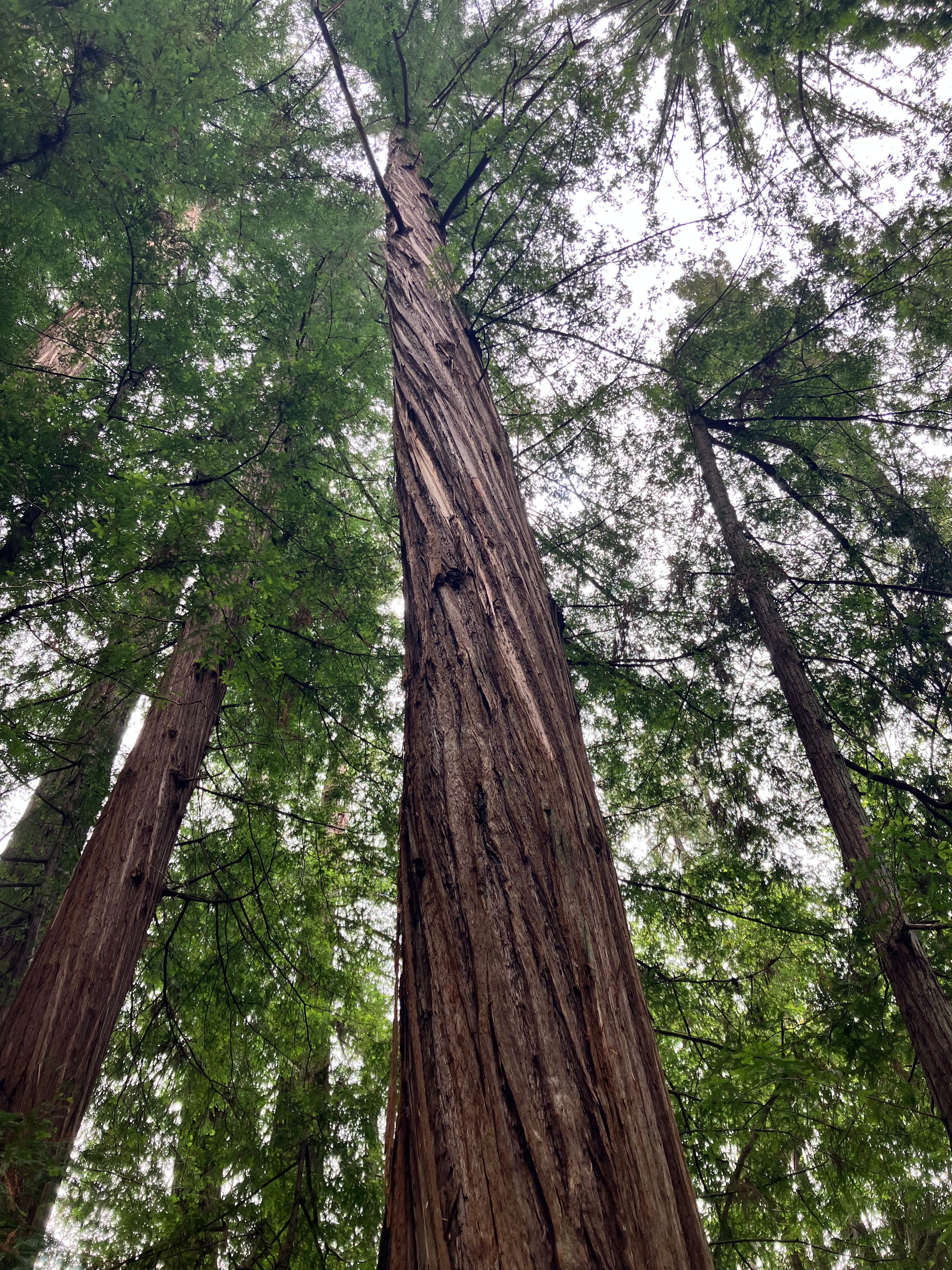
Andy and I started our hike at a parking lot near the back edge of the park and headed into the redwood groves. There is nothing like the colors of a redwood forest - every shade of green and brown imaginable. The electric green of new needles. The red-brown bark, sometimes slashed with the dark brown scars of a fire from long ago. The feathery green of the ferns that cover the forest floor. The light brown duff that coats the ground, dampening the sound and giving the redwood forest its famous silence. The dark mossy green covering fallen logs. The blurry, rich blue green of the redwood needles as you crane your neck to look up hundreds of feet into the forest canopy.
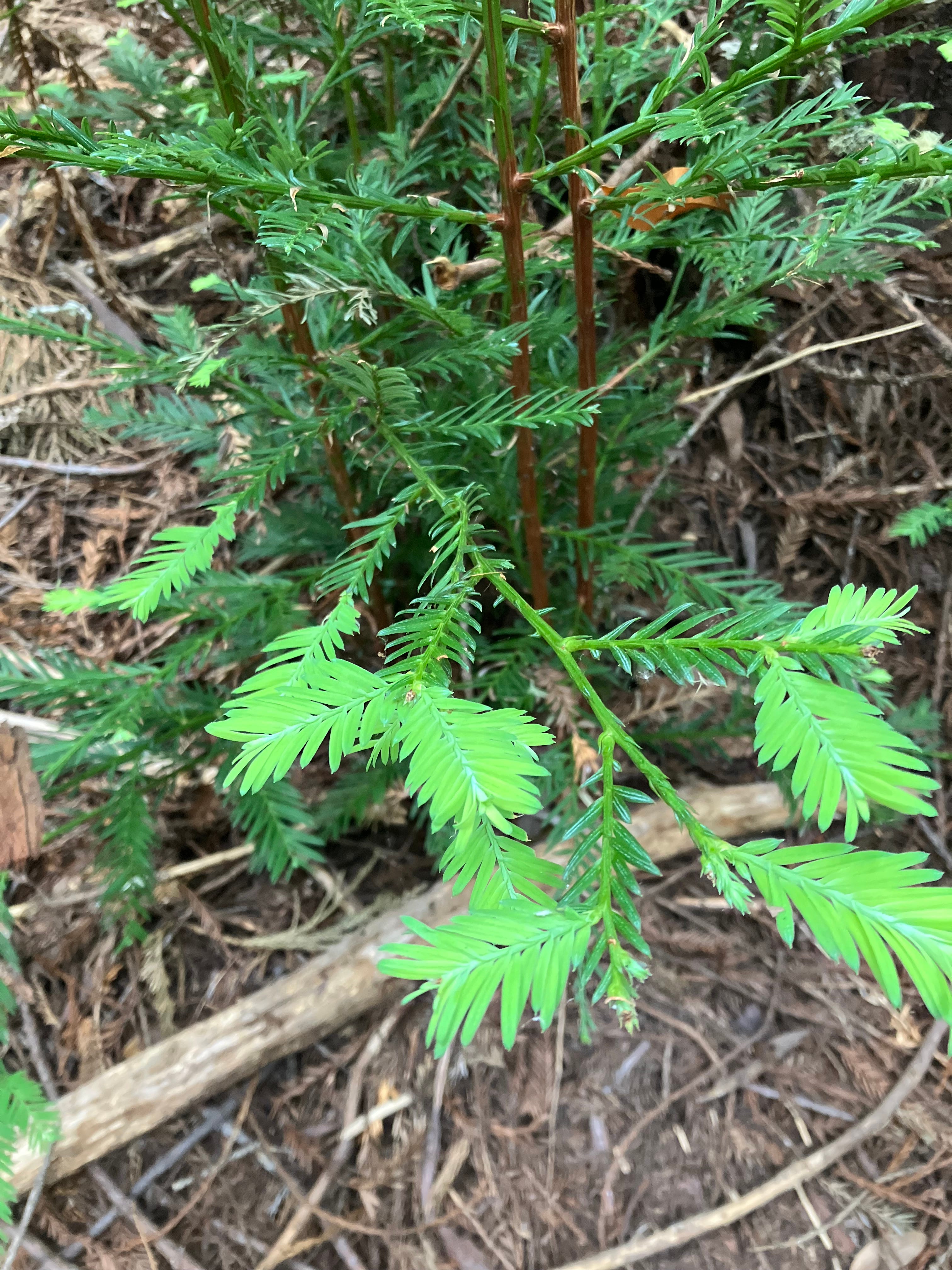
The calms that comes with noticing all these greens has scientific backing. It turns out that for evolutionary reasons, humans are really good at detecting different shades of green - we can detect more hues of green than any other color. Andy told me that image compression algorithms are made with this in mind — basically they leave more room for variations of green than for other colors. Some scientists believe that since our eyes are so good at detecting green, it’s easier to look at the color, thus putting less strain on our nervous systems, which is what makes green a calming color.
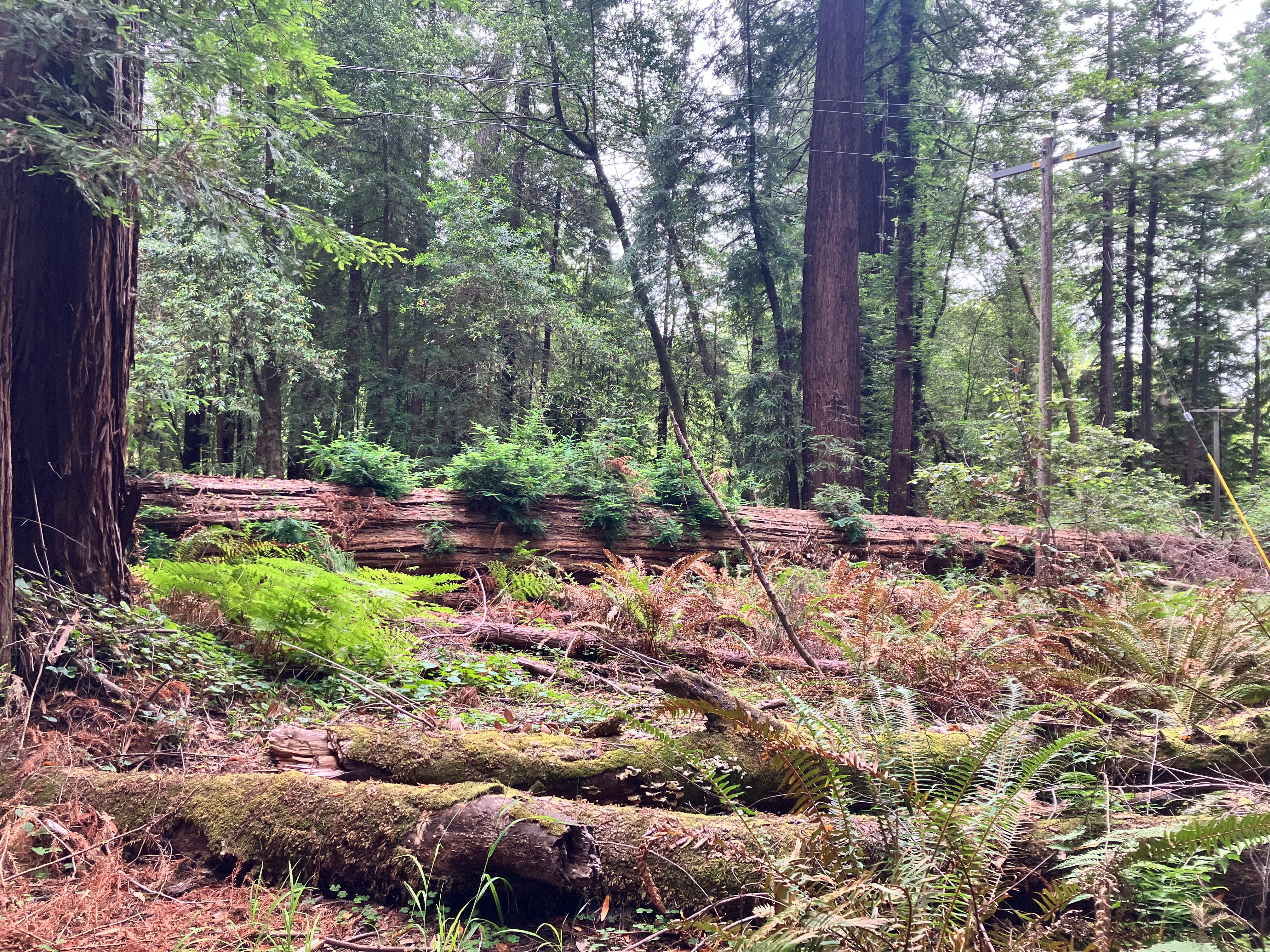
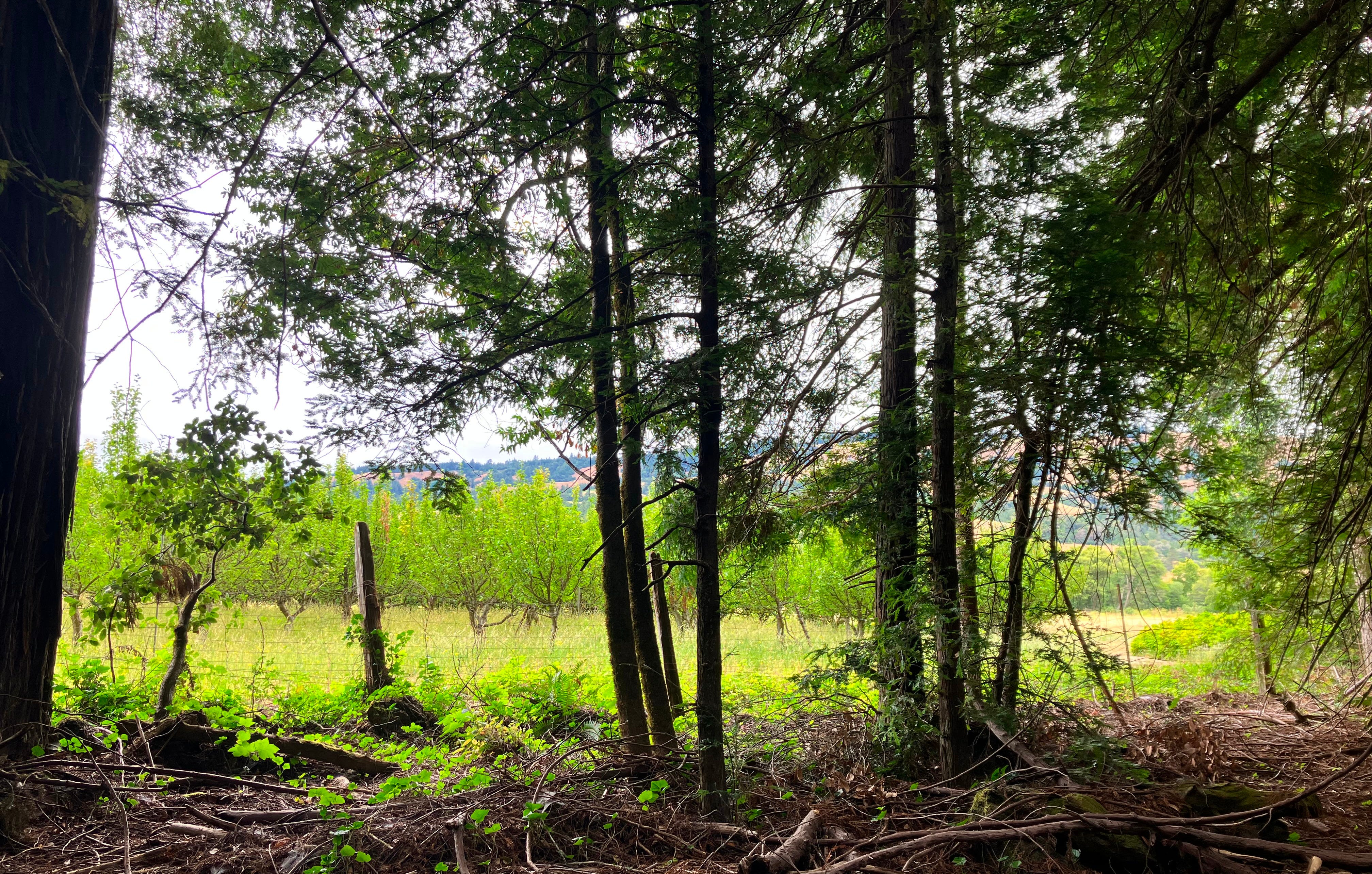
This redwood forest was louder than other ones we’ve been to — we heard more birds and saw more animal life than in other forests. Andy and I speculated on the reasons for this. Many redwood forests we’ve visited have been tucked into narrow valleys — isolated and dark. Hendy isn’t isolated in its own steep little valley; it’s bordered by meadows and farmland and isn’t the only ecosystem within hearing distance.
We walked to the edge of the grove, where there was a fence, marking the boundary between the park and the neighboring apple farm. We saw a sudden movement in the apple orchard and a deer leapt through the trees, stopping for a snack. It felt like we were in a Disney movie - I half expected a flock of birds to start putting me into a beautiful ballgown. But of course this was real life — after nibbling on an apple, the deer simply bounded away.
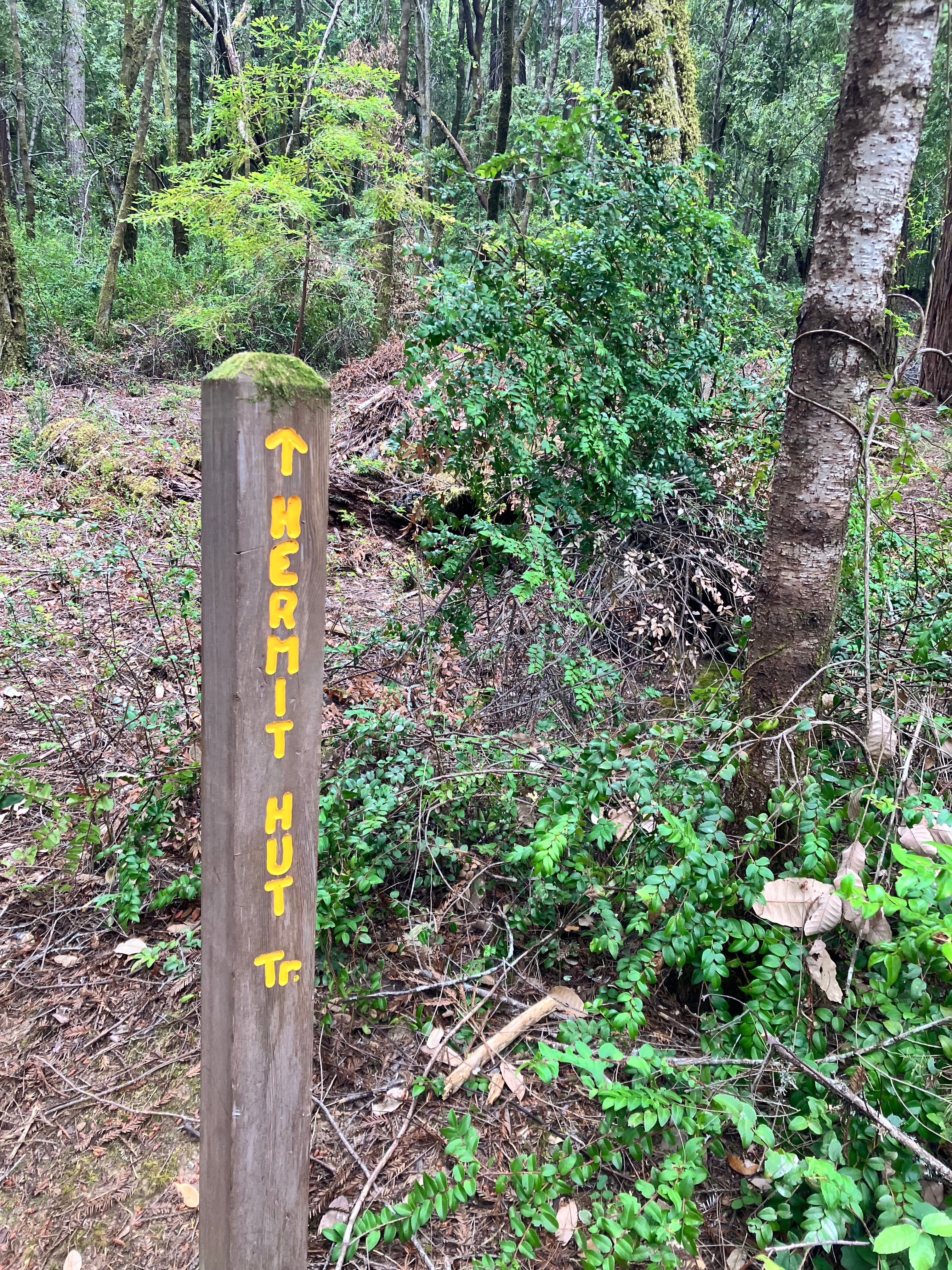
One of the trails marked on our map was to a “hermit hut.” I’d visited a hermitage in the UK; I associated them with aristocratic estates so it seemed incongruous to have one in a redwood grove in California. I wanted to check it out.
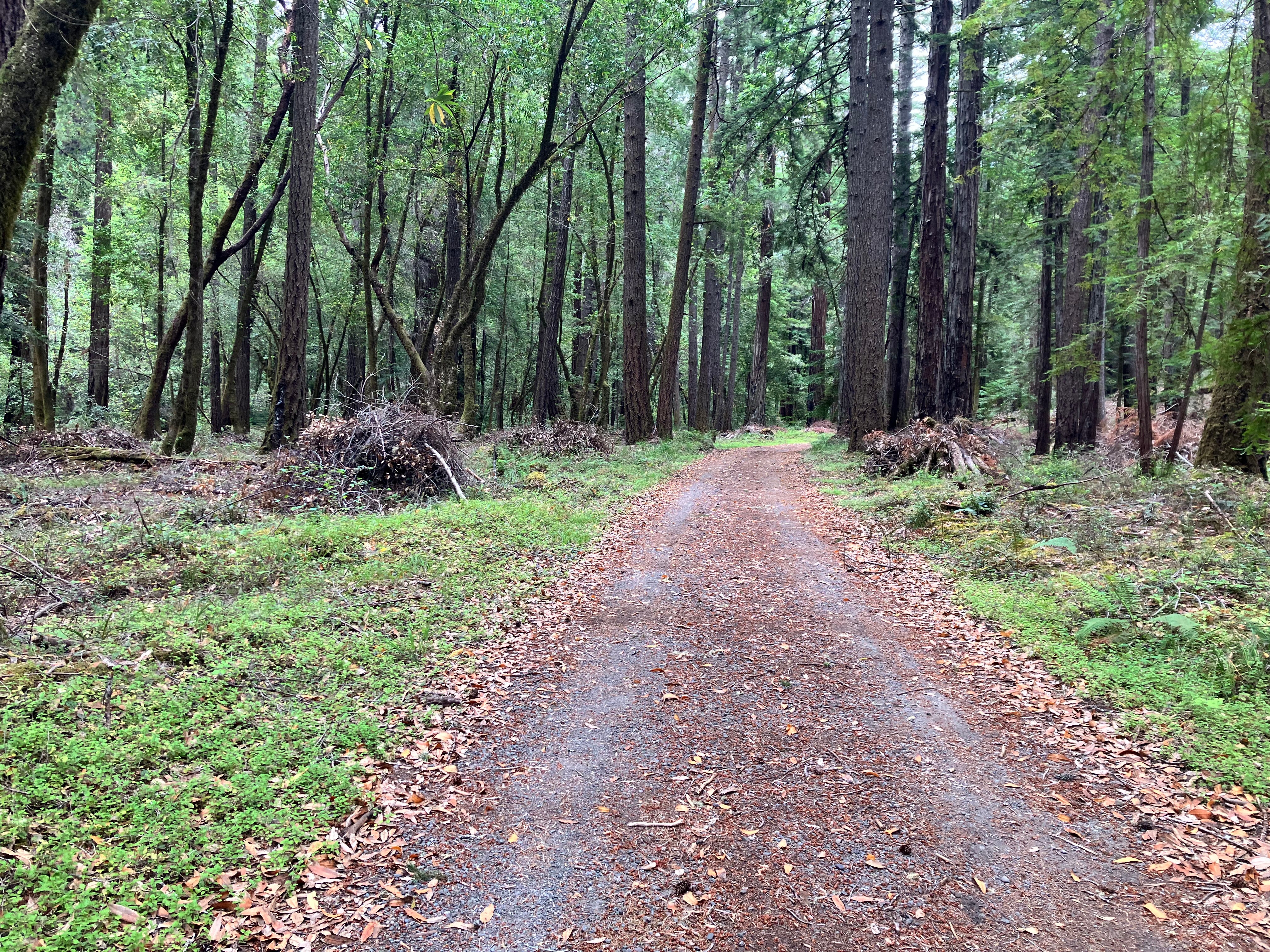
Finding the trail was tricky — we doubled back over paths and fire roads and spent time wandering up the main paved road through the park, where we were passed by two small boys flying down the hill on their bikes from the other direction, whooping with their feet off the pedals.
Finally we found the right path and climbed up a hill to the hermit hut. I was surprised to find that it wasn’t some English folly — it was a simple lean-to built into a redwood stump. It served as a home of Petro Zailenko, a Russian World War II veteran who lived in the woods for nearly 20 years, starting in the 1960s. Known as the “Hendy Hermit,” Zailenko jumped off the Russian fishing trawler he was working on when it stopped in San Francisco. Undocumented, he held various jobs in northern California, including at a mill in Anderson Valley, until he was asked for his immigration papers by a boss and fled to the woods.
Zailenko’s immigration status left him terrified of authority figures (he did not want to be sent back to the USSR), so he retreated to what was then right outside the official borders of Hendy Woods State Park, living off the land and the occasional kindness of campers and neighbors. Zailenko made his own shelters, a few of which remained; the land he lived on was later acquired by the State to expand the park in the 1970s/80s. When he died in 1981, park rangers spread his ashes in the park, so he could forever be amongst his beloved redwoods.
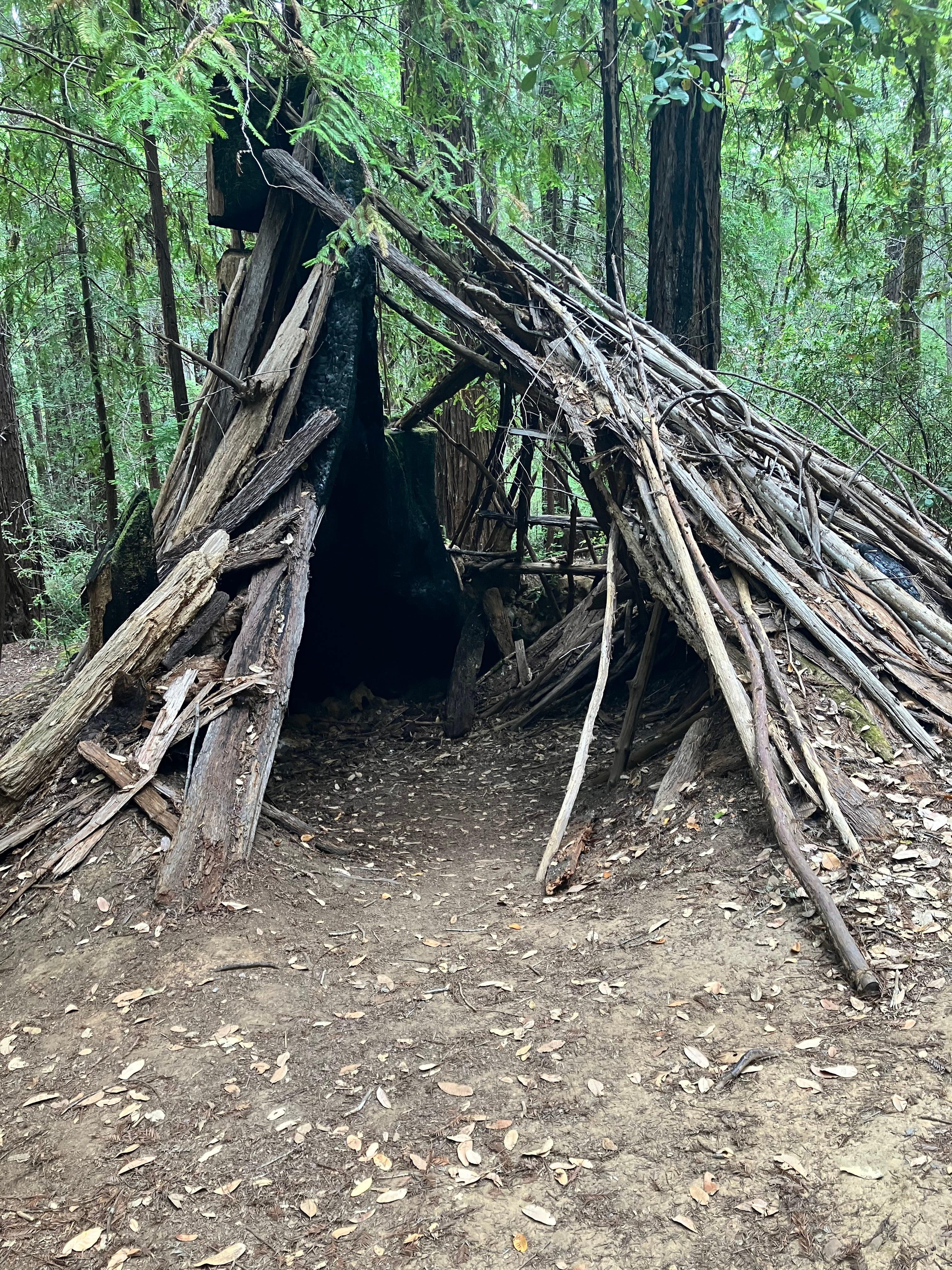
Rumor has it that Zailenko was imprisoned as a POW by the Nazis. He must have seen and experienced terrible things in his life, and it’s understandable that he seemed to find some measure of peace among the beautiful old redwoods. I did have mixed feelings about walking around the former home of a man who seemed so intensely private, but making the trail and preserving his story also seem important. That the life of a man who died with $4.38 to his name is just as valuable as a wealthy Englishman who built a hermitage in the 18th century. That both homes are worth a visit and have something to teach us.
Back to the creation of Hendy Woods State Park. Hendy’s nephew sold the land to a timber company and the land changed hands a number of times but was miraculously never logged (some speculate this was because there weren’t any local mills that could process trees that big). In 1938, the Unity Club, a local Anderson Valley women’s club, heard a lecture about how the redwood forests of Sonoma and Mendocino Counties could be preserved as parks. The women decided to take on the project of turning Hendy Woods into a park - they formed committees, lobbied the government, and brought press attention. In 1958, the State bought the land. Five years later, it opened as a state park.2
That wasn’t the last time the Anderson Valley community had to campaign for Hendy Woods. The park was slated to be closed as part of the 2012 California state budget. With the memory of Zuccotti Park still fresh, “Occupy Hendy Woods” began. Organizing, a fundraising campaign, and the creation of an organization called the Hendy Woods Community helped save the park for future generations.
Armstrong Redwoods State Natural Reserve is another example.
More on the story of the creation of Hendy in this great article by Kathy Bailey — “It Was (Mostly) Those Women.”