
Olompali
The Grateful Dead, the Bear Flag Republic, and a possibly murderous dentist

Olompali State Park sits at the end of a dead-end road parallel to Highway 101 in Northern Marin County. The big parking lot was surprisingly sparse for such a beautiful, sunny day. As Andy and I walked into the park, we both felt the vibes were off.
The vibes only got weirder as we walked on. Giant signs warning of ticks were everywhere, which made sense given the tall, disheveled grasses. We walked past a yellow clapboard house that looked a bit worse for wear. This was the park’s visitors center, though the hours were extremely limited and the building was closed.
We continued on up the hill, passing a beautiful old wooden barn with a strange tree stump out front. The views went on for miles, out across San Pablo Bay.


The barn seemed to be the only well-cared for building on the property. As we continued up the hill, we passed more shabby, derelict buildings, the paths to them overgrown with grasses. Fearing ticks, we stuck to the main path, which eventually took us past the buildings and into the more “naturey” part of the park.
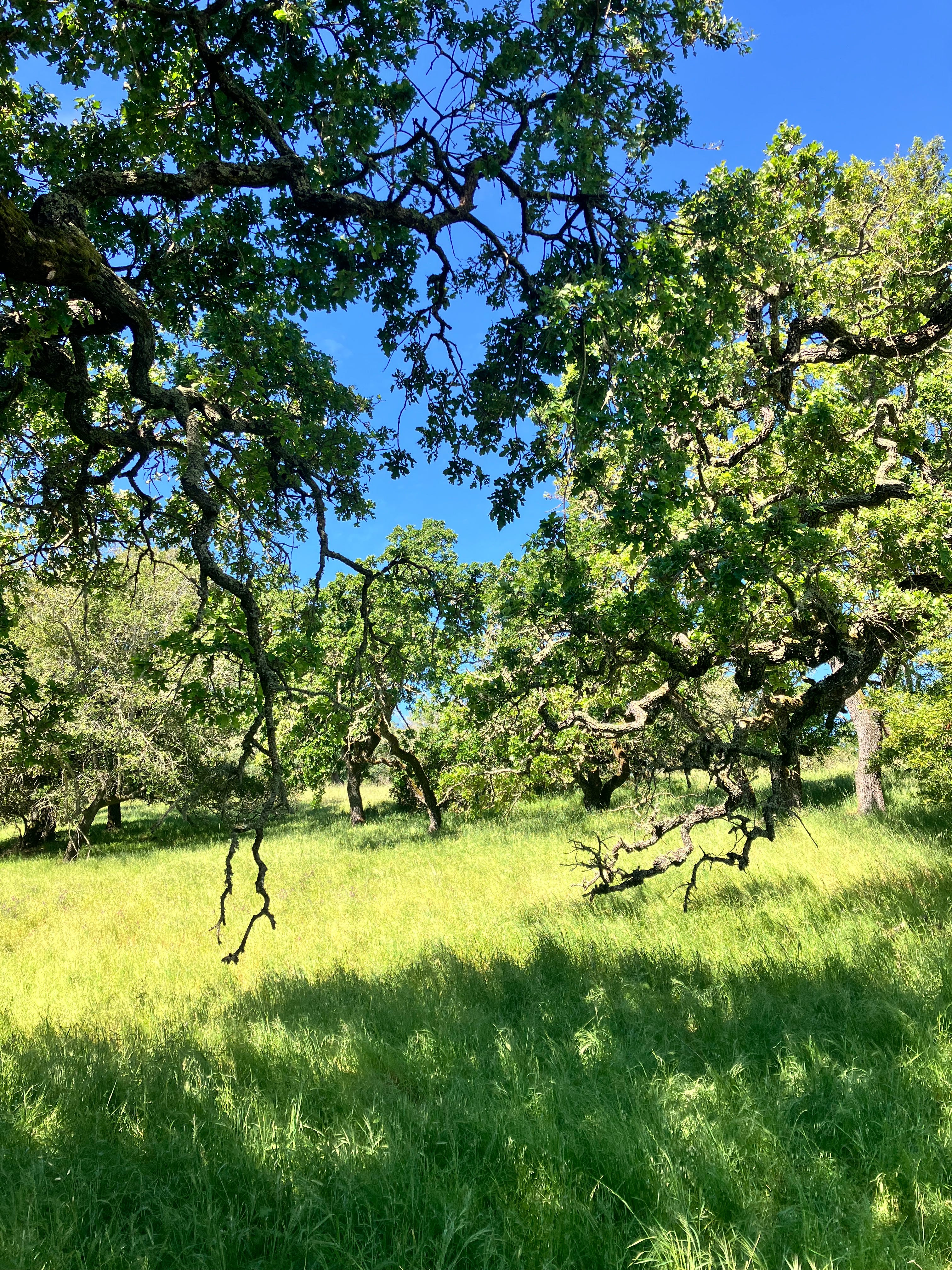
To the left ran a creek, shaded by trees. Gnarled oaks splayed across the hills, creating patterns of dappled sunlight. A wild turkey strolled across the path, startling us because it was alone. I don’t think I’ve ever seen a solitary turkey — what was going on with this place?
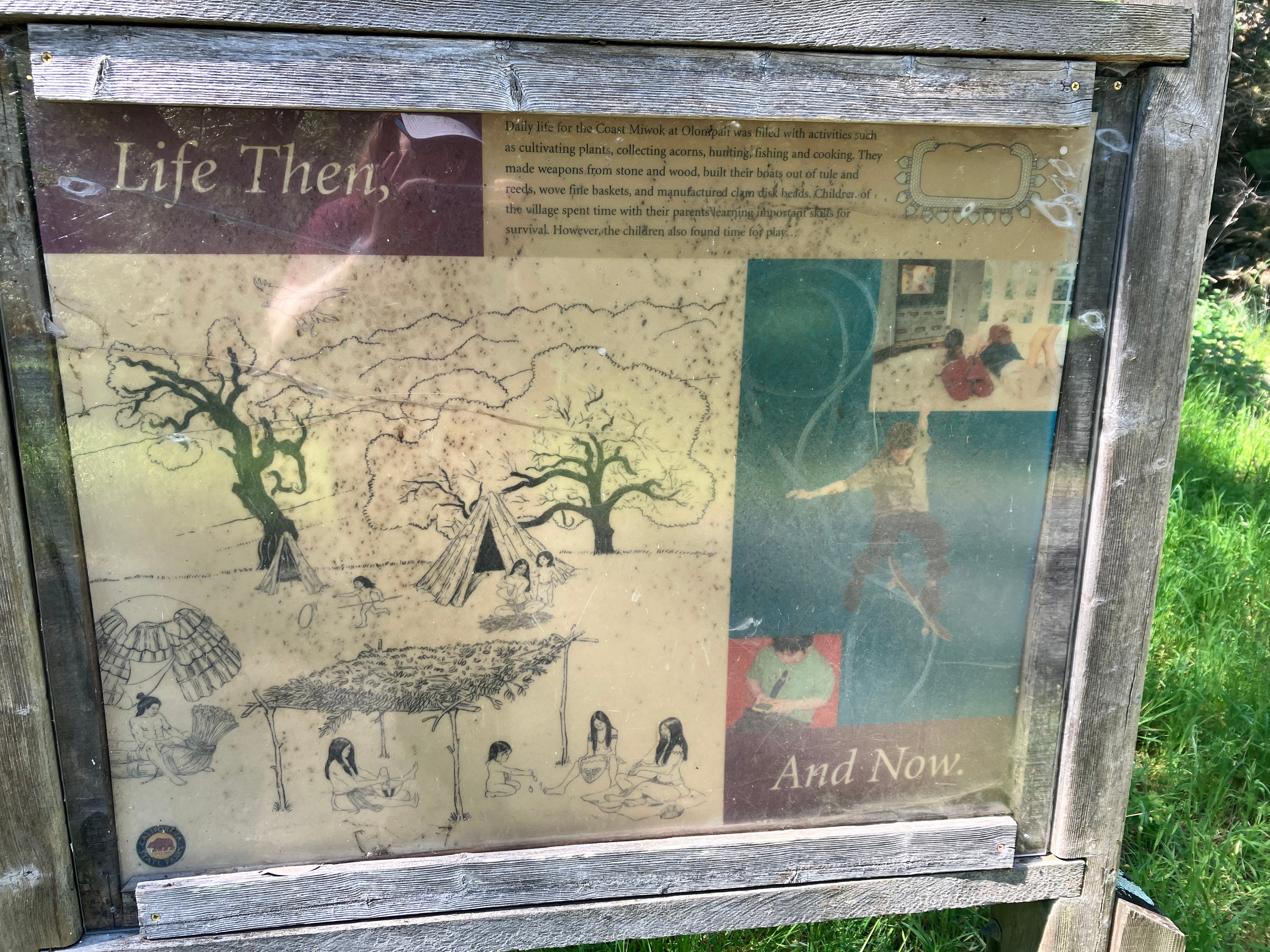
The path led to a recreation of a small Coast Miwok village and a chaotically labeled native plant garden. We could’ve continued up into the hills, but decided to turn around. It was hot and the whole place gave me the heebie-jeebies.
We walked down the hill on a different path, passing a stucco mansion boarded up due to a fire. There wasn’t really an explanation of this haunting sight, so we continued down to our car and drove away.
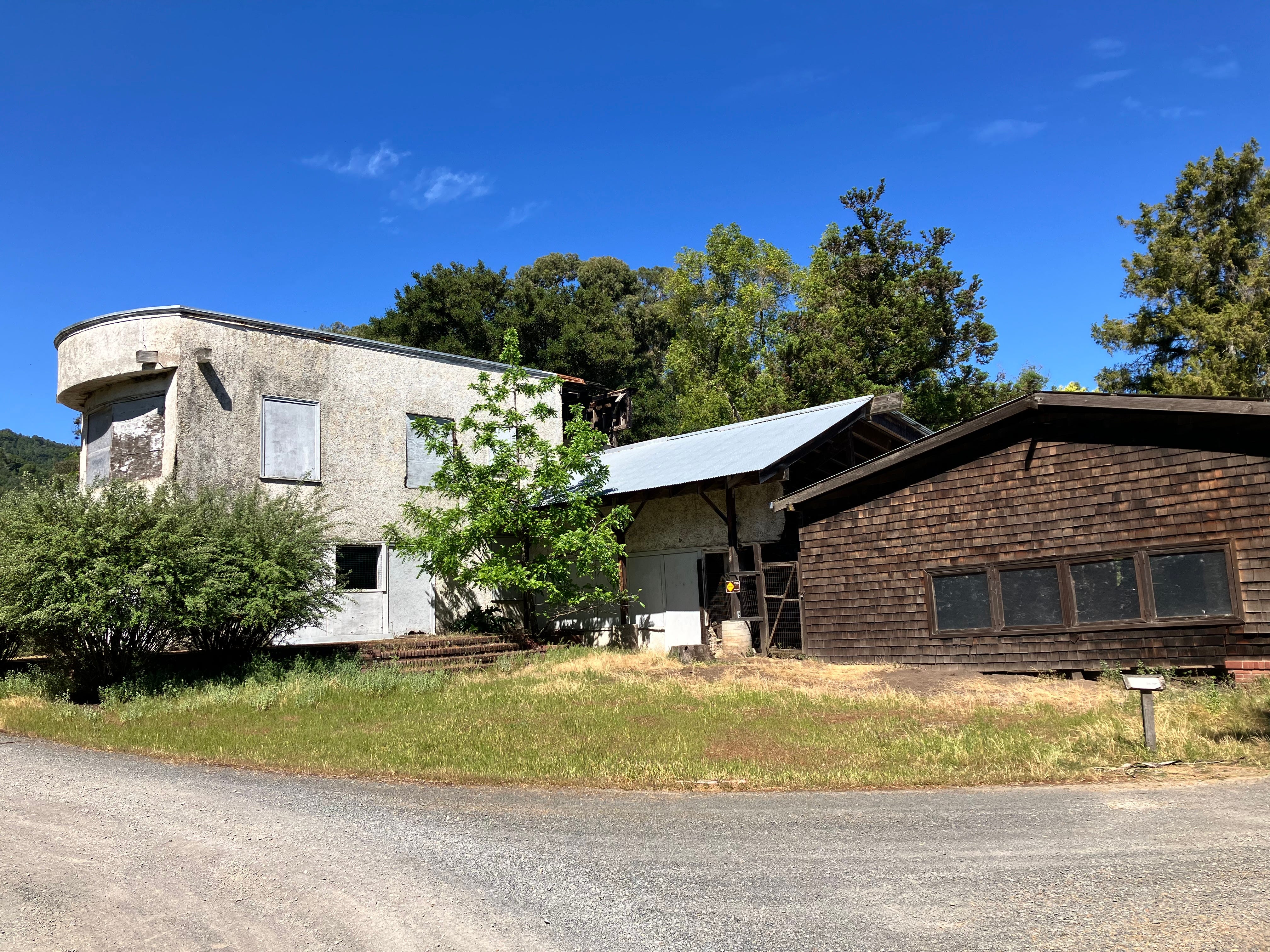
I almost didn’t write about this walk because it was such a strange combination of unsettling and boring. Weeks later, I looked into its history and discovered why it felt so unsettling — and also that this park is anything but boring.
The Coast Miwok people lived in the village of Olompali for thousands of years in what was likely the largest indigenous village in Marin County. The land continued to be home to the Coast Miwok until the mid 1800s. The Mexican government granted the tribe’s final Hoipu (headman) a deed to Olompali village and the surrounding lands. The Hoipu, Camilo Ynitia, was one of only two native people given a land grant by the Mexican government. (Never mind the absurdity of deeding land to a person whose people have been living on it for generations).
Tensions between Mexico and America were heating up when Camilo Ynitia was granted the land, and those tensions came to Olompali. In June of 1846, the only deadly battle of the Bear Flag Revolt, a short-lived rebellion against Mexico for an independent California republic, occurred in Olompali. The Bear Flag Revolt lasted less than a month — it was basically a precursor to the Mexican-American War — but it had a lasting impact on our state; today’s California flag has a bear on it with the words “California Republic.”
Camilo Ynitia sold Olompali in the 1850s to James Black, who granted it to his daughter Mary on her wedding day. Mary married a dentist, Galen Burdell, who became wealthy from inventing a tooth powder. Galen killed Mary’s mother (unclear if it was an accident) while performing a dental procedure. James Black began drinking heavily after his wife’s death, falling off of a horse and eventually dying. He wrote his daughter out of his will, a will she tried to invalidate by ripping his signature off the bottom of it and eating it. After numerous court battles, she got to keep the property, which she passed on to her son who built a giant stucco mansion with over two dozen rooms on the property.
Eventually, Olompali ended up in the hand of the University of San Francisco, a Jesuit school near my house. USF intended to use it as a retreat for priests but ended up renting it out instead.
And this is where the story gets truly wild.
In the summer of 1966, the Grateful Dead rented out Olompali, putting the property on the radar of Bay Area hippies. In 1967, Donald McCoy rented Olompali to be the home for his commune.
McCoy was born wealthy and made even more money as the first houseboat developer in Sausalito. It is said that Otis Redding wrote (Sittin’ on) the Dock of the Bay on McCoy’s houseboat (though I’ve also heard he wrote that song at the Berkeley Marina so who knows). McCoy got tired of the fast-paced houseboat mogul lifestyle so took his three daughters and around 20 other people that he called “the Chosen Family” to Olompali.
The Chosen Family was pretty much what you’d expect out of a commune in the 1960s. The Grateful Dead were regular house guests, even shooting one of their album covers there. The Family baked hundreds of loaves of bread every week, which were distributed by the Diggers to hippies in San Francisco. Each week, the adults would pick a child’s name out of a hat and would act as the parent to that child for the week. Drugs were plentiful. During one police drug raid, when asked who owned the seized pot, McCoy said “It belongs to God. I just smoke it.”
After less than two years, as happened with so many of the communes of that era, things started to get dark. McCoy fought with his ex-father-in-law about money, eventually losing custody of his kids and going to a psychiatric facility. People started moving in who didn’t hold the original ideals of the Chosen Family. The old electrical wiring in the mansion caught fire and half the building burned down. Two toddlers fell into the swimming pool and none of the commune’s beater cars would start; the girls died due to the delay. The death of the children was the final straw for USF (the Jesuits still owned the property) and the place was shut down. In the late 1970s, the land was sold to the State of California and it became a state park in the 1980s.
It seems that not much has changed at Olompali since the fire in the late 1960s, with the exception of the reproduction of the Miwok village. This is not a park that has seen a lot of investment — apparently it’s regularly on the list of state parks to close during economic downturns. The place seems frozen in time, strewn with old debris and falling apart buildings, the few interpretive signs clearly from over 30 years ago. But beneath the ruins and seeming neglect is a fascinating and surprising history — I’m glad I chose to dig a bit deeper.
What a great story, that is so cool
Wow! Beautiful property. Sounds like material for some kind of film-a documentary at least. Thanks for doing the research and sharing. 🙏