
Spacewalk
Walking across the universe at Sugar Loaf Ridge State Park

In our ongoing quest to visit all of California’s 280 state parks, Andy and I headed to Sugar Loaf Ridge State Park last weekend.
Sugar Loaf is in Sonoma County, more than an hour north of San Francisco. We set out mid-afternoon, the marine layer mostly burned off, save for a small patch of gray right on the Golden Gate Bridge - it looked as though the fog was commuting from Marin to San Francisco.
North we drove, soon leaving the highway for country roads. People say that California doesn’t have seasons but we do - they’re just subtle. Autumn shows up in the vineyards, the rows of grapevines turned from green to yellow and orange and maroon.
One of the vineyards we drove past was the Jacuzzi Family Vineyard, a garish Italian villa. Foolishly, I hadn’t realized that Jacuzzi is to hot tub what Kleenex is to facial tissue and that there is an actual Jacuzzi family. The descendants of Mr. Jacuzzi extricated themselves from the tub business long ago and now make, according to Andy, terrible wine.
We drove past miles of vineyards, the land flat and dry and then turned onto a twisty road that took us toward the mountains. The temperature immediately dropped ten degrees. The air was cool and damp. Besides us ran a small creek, trees towered over us, and the banks of the road were covered in an electric green moss. The contrast from the arid vineyards we had just left was startling.
We made it to the entrance of the park, where a volunteer docent kindly highlighted a map of trails for us, and pulled into the parking lot by the Robert Ferguson Observatory. The observatory is operated by the Valley of the Moon Observatory Association and is the largest observatory on the West Coast devoted to educating the public about astronomy. The ring of hills that surround the observatory block light pollution which makes it an excellent spot for stargazing.
Andy picked this park because it has a scale model of the solar system. When he was a kid, his first elementary school was arranged along one long hallway, and Andy and his dad would talk about how it was a perfect spot for a scale model of the solar system. They never built it, but Andy’s got a bit of a soft spot for planetary models, so once he found out about the scale model at Sugar Loaf, we had to go.
We started in the parking lot with the sun. We were both a little disappointed that the model sun was 2D and not a big ball, but we managed to swallow our disappointment and move on.
The Planet Walk presents at the same scale the size of the planets and the distance between them. In order to fit the solar system into the park, the designers of the Planet Walk shrunk is more than 2,360,000,000 times. This means each step you take on the walk is about one million miles; if you take five steps a second, you move at the speed of light.
The man who spearheaded the Planet Walk, Angelo Parisi, was no stranger to long-distance walking. He was a letter carrier in Novato, walking eight miles a day to deliver mail. Parisi was also a volunteer docent for the Valley of the Moon Observatory Association and thought the Planet Walk would be a fun way to demonstrate the vastness of our solar system. His dream became a reality in the late 1990s after being approved by California State Parks and built by a local Boy Scout troop.
We followed a path that curved around a field, recently burnt to mitigate wildfire risk, which is a serious concern in this area. 80% of the park was burned during the Tubbs Fire in 2017 and 75% of it was burned again during the Glass Fire in 2020. As the climate catastrophe worsens, California’s risk of wildfire continues to grow, making Indigenous land management techniques such as controlled burns all the more important.
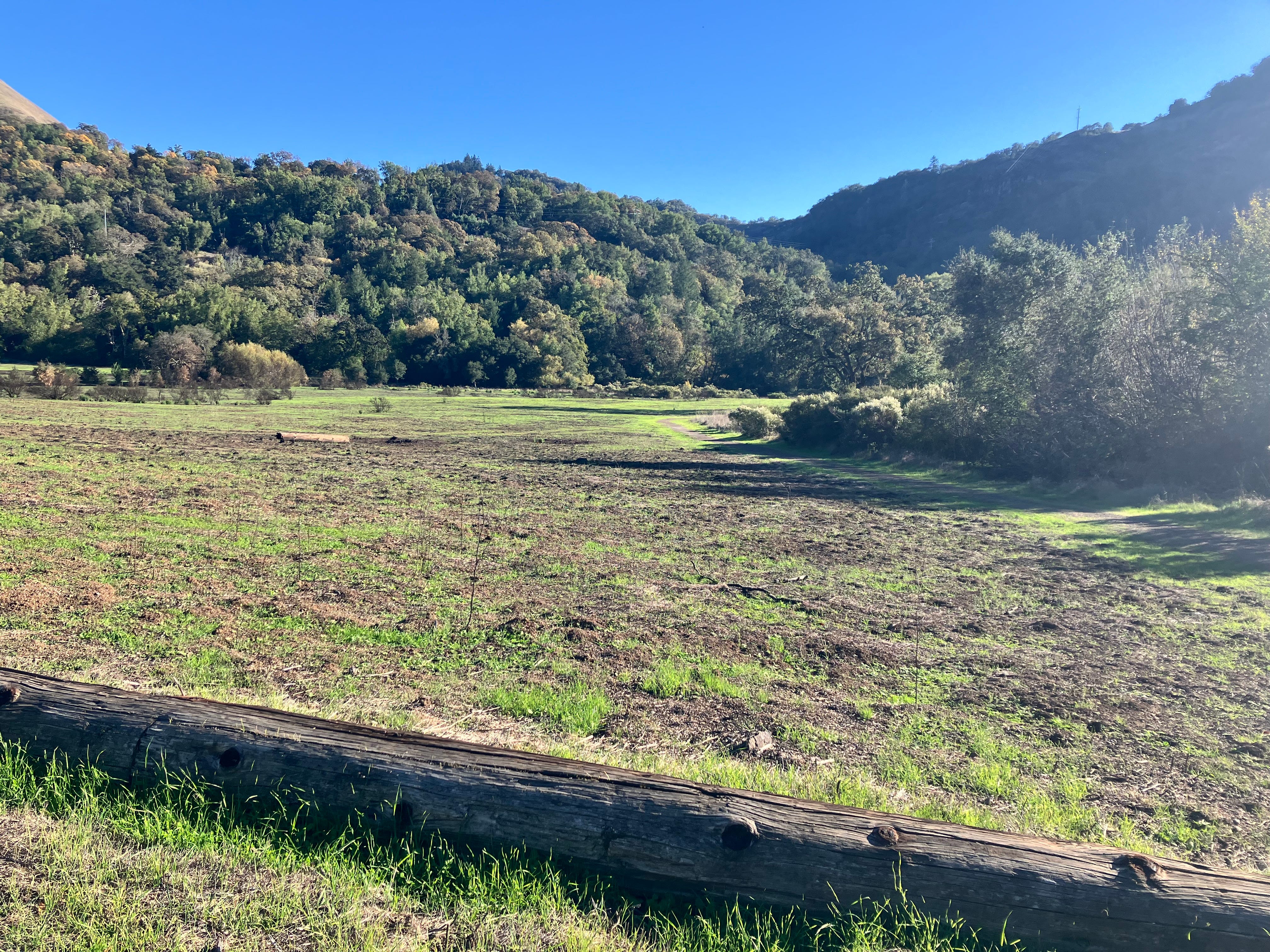
Next to the charred field was Mars. Somehow we had missed Mercury, Venus, and Earth. We figured we’d catch them on the return trip and continued on to Jupiter, making our way through a forested area, the late sun lengthening our shadows.
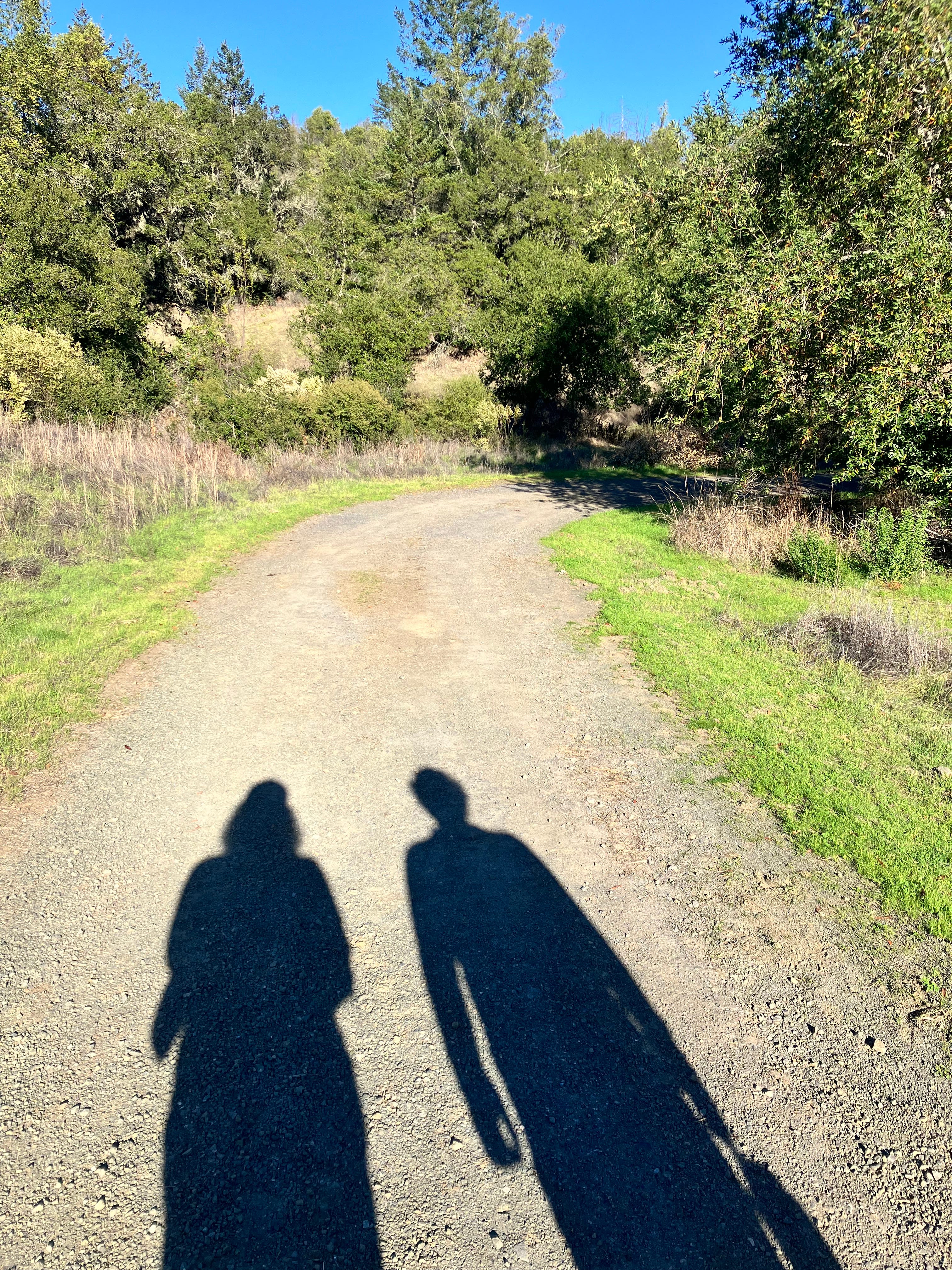
After crossing a wide, sturdy bridge over the tiniest trickle of a creek (that will hopefully be roaring come spring) we climbed upwards through the forest, passing Saturn and Uranus. We followed a long series of switchbacks farther up the mountain, the trees gradually giving way to shrubs.
We spotted a precariously perched bench ahead — it was Neptune! We caught our breath at the bench and looked down into the valley, spotting the observatory parking lot, where we started our journey at the sun. It was at this point that I started to understand the vastness of space.


On the mountain to our left was a small vineyard. It seemed an absurd place for a vineyard - remote, steep, inconvenient. Andy later discovered it was Robin Williams’ family vineyard, named after his kids. Williams named the estate surrounding the vineyard Villa Sorriso (Villa of Smiles) and its remoteness was the point — a quiet place where he could wake up and see beautiful vineyards.
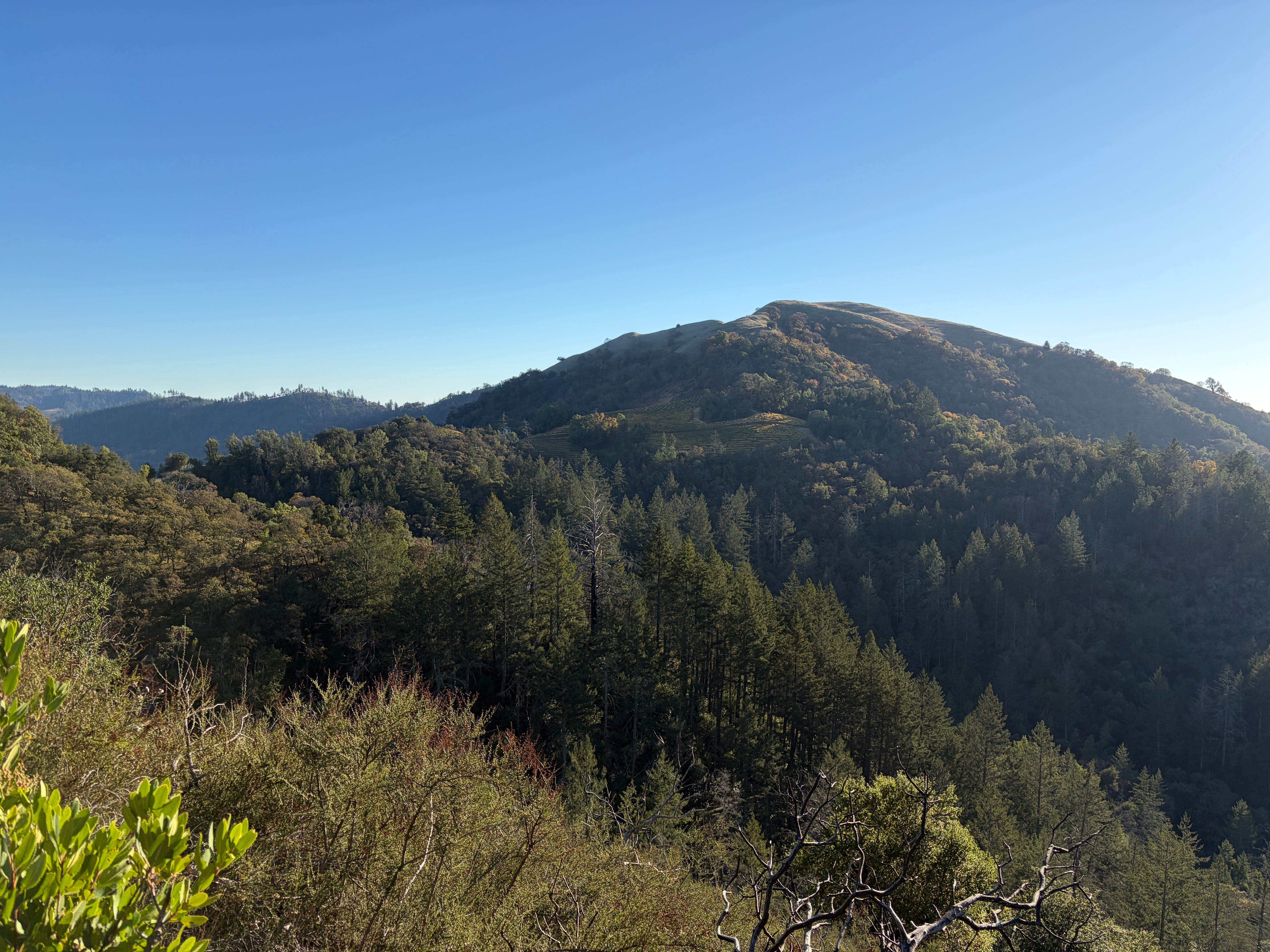
We couldn’t linger too long though - we had to keep going for over a mile to get to Pluto. Despite the tragic demotion of Pluto from planet to dwarf planet (not calling it a planette was a real missed opportunity), Pluto is included in the Planet Walk as a representation of the last part of our solar system — the Kuiper Belt. The Kuiper Belt was only confirmed to exist in 1992 and includes Pluto and other dwarf planets like Haumea, Quasar and Makemake.1 (There’s possibly another part of our solar system beyond the Kuiper Belt called the Oort Cloud, but it’s theoretical and much further away and really how much can you expect to fit into one state park?).
ANYWAY, the journey to Pluto was rough. We wound around the mountains, sure that we’d reach Pluto at the next crest, only to be disappointed each time. Finally, after over a mile of ups and downs, we came to a series of switchbacks through the brush. This is when Andy casually mentioned I should watch out for scorpions. “All the pictures of this park online were of people with scorpions and they’re crepuscular so they start coming out now.”
“Thanks for waiting to tell me this until the middle of the hike,” I said. Good thing I was wearing big hiking boots.
Luckily the hike was scorpion free and at long-last we made it to Pluto. A bench dedicated to Christine Churchill-Kozel “Docent Dreamer Dancer” and decorated with flowers and a ballet slipper provided a welcome place to rest and look over the valley, awash in the golden light of the setting sun.
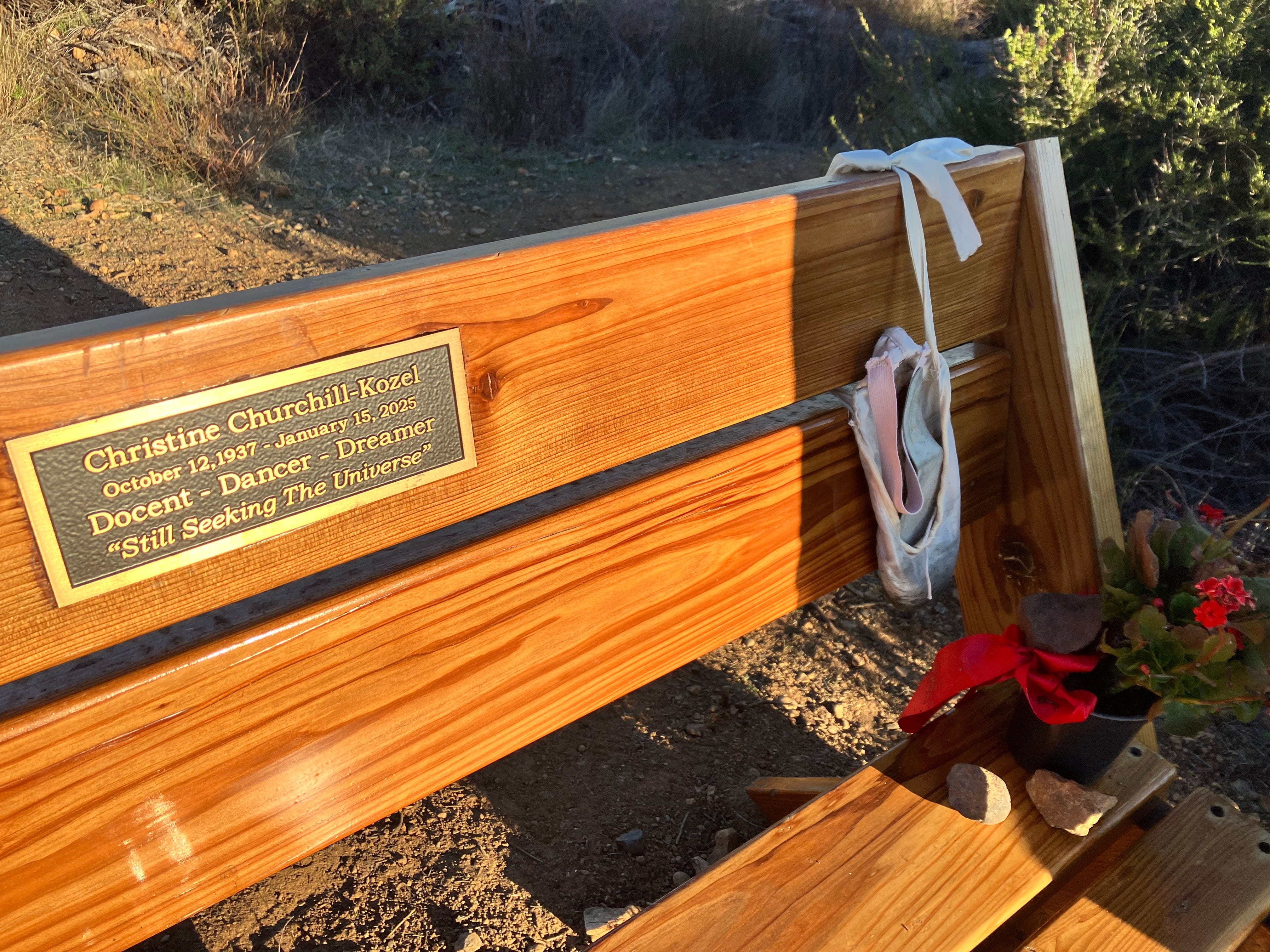
According to the plaque for Pluto, at the scale used for the Planet Walk model, the nearest neighboring star would be 10,000 miles away. In other words, I’d have to walk to South Africa to get to the next stop.
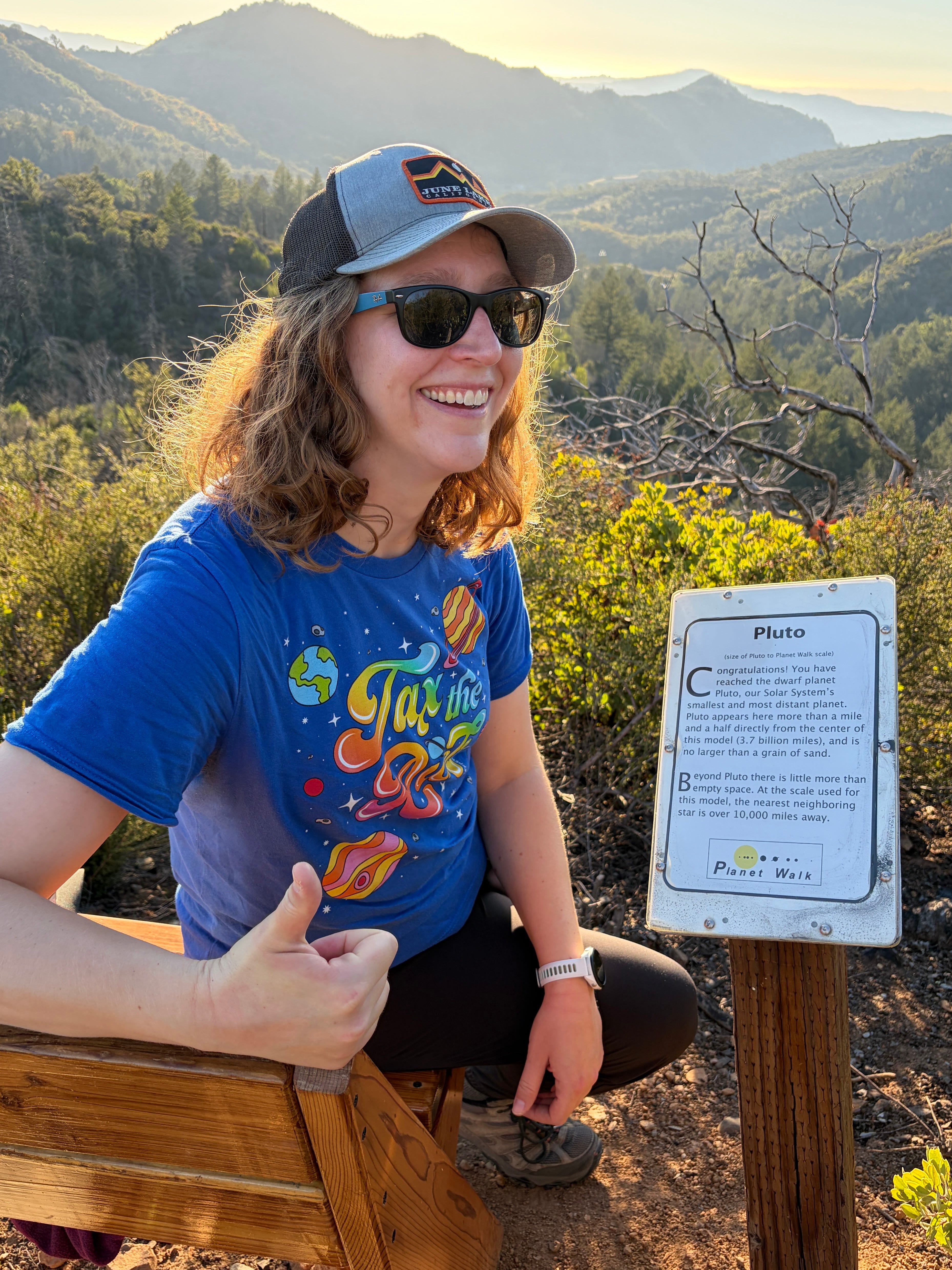
Sunset was less than an hour away, so we didn’t linger long. We walked quickly down the hills, past sun-bleached tree branches and through clouds of gnats. We took a small detour to a little grove of oak trees which shaded a cluster of beautiful Adirondack chairs. We were miles from a road and I wondered how the chairs had made it up there.


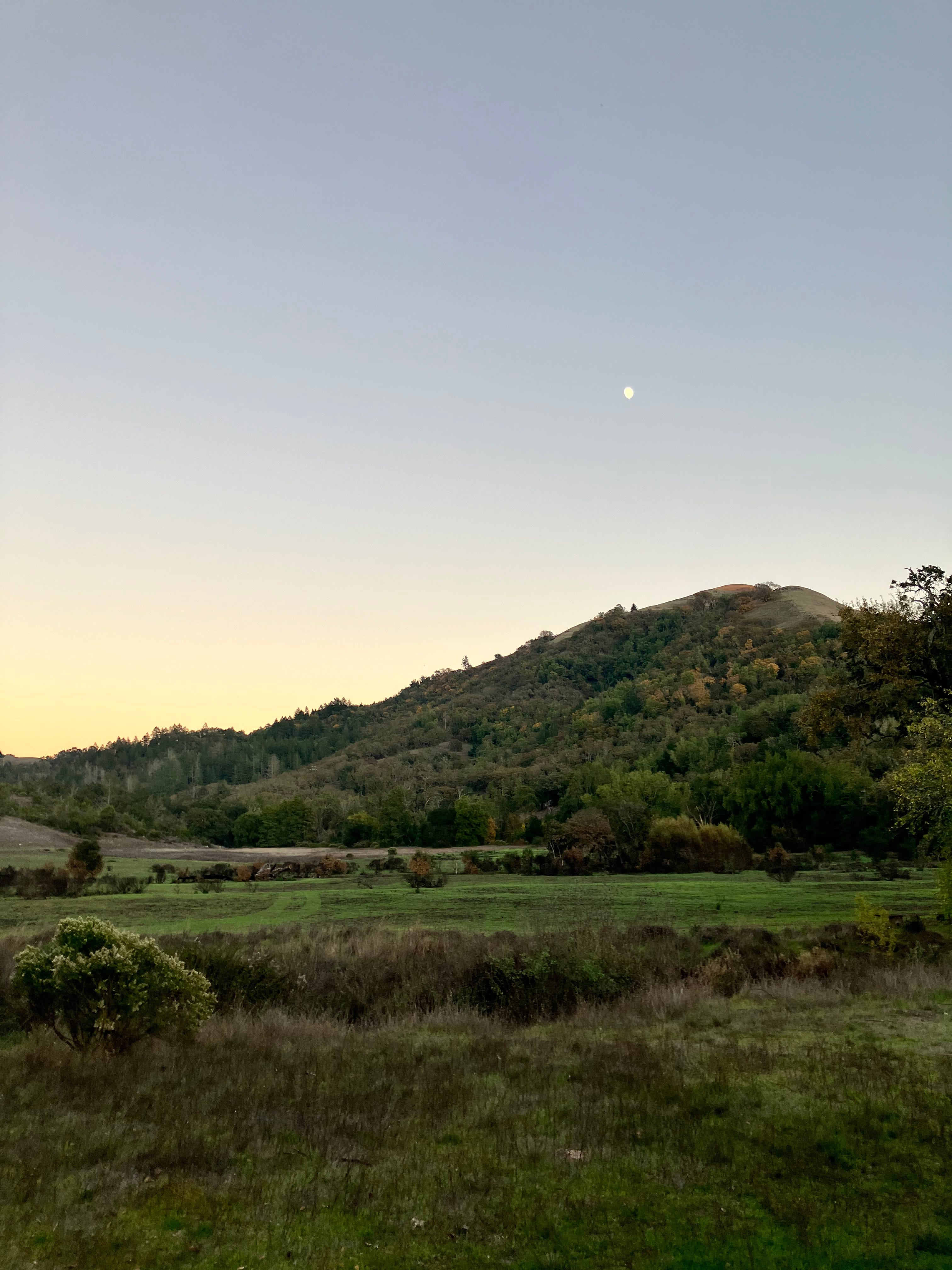
Down we went through the brush and past the Toyan shrubs with their cheerful red berries and through the forest and over the dry creek beds. When we made it to the meadows, we slowed down a bit, admiring the rising moon, white against a lilac sky. The setting sun cast a yellow glow behind the mountains.
As we re-approached Mars, we passed a father and his son who had also missed the first three planets. We all ended up back in the parking lot, poking around for signs of them.
It turned out that Mercury and Venus were across from the Sun, on the other side of the parking lot. And thanks to instructions on the Venus plaque, we found Earth, posted on the side of the observatory. Remarkable that the first three planets were all in the parking lot while the distance between Neptune and Pluto was well over a mile.
All told, we’d walked over 7 billion miles. Tired and out of water, we were glad to be back to earth, and we headed home.
All of these dwarf planets are named after creation gods of various religions and I went down a Wikipedia rabbit hole of astronomical object naming conventions which led me to this naming guide from the International Astronomical Union in which I learned that Plutinos (a type of astronomical object) must be named after gods of the underworld and Centaurs (apparently another type of astronomical object) must be named after “mythological Centaurs (a < 30 AU, q > 5.5 AU)” or “mythological Chimeras (if q < 30 AU).” This made me wonder how many named centaurs and chimeras there are. Turns out there are over 50 named centaurs, according to Wikipedia, but Wikipedia did not provide a similar list of chimeras.
Also, another celestial body called a Jupiter Trojan must be named after Olympians or Paralympians (“if H is fainter than or equal to 12.0”, whatever that means). Sadly, there is not a Jupiter Trojan named after Jackie Joyner Kersee, the first Olympic athlete to pop into my head (#90skid). In fact, the Jupiter Trojans are named after obscure (to me) athletes, including a wheelchair fencer from Italy named Beatrice Maria Adelaide Marzia Vio and Brigitte Yagüe Enrique, a Spanish taekwondo silver medalist. The only athlete I recognized on the list was Arvydas Sabonis, part of the famed 1992 Lithuanian bronze-medal winning Olympic basketball team. Well he’s famous in my family, at least, and you should watch the excellent documentary The Other Dream Team if you also want to become an ardent fan of early 1990s Lithuanian basketball.
Now I want to go to that park! What a hoot.